The 30-second version
- ✓Fury is 206cm with a 216cm reach; Joshua 198cm with 208cm. Fury has never lost inside the distance; Joshua has been stopped twice (Ruiz 2019, Dubois 2024).
- ✓Joshua's path: rounds one to four. Double jab downstairs, right hand over Fury's lazy jab, never let the fight settle.
- ✓Fury's path: feints that freeze Joshua, the jab from both stances, and clinches where Joshua carries his weight.
- ✓Joshua's losses share a pattern: opponents who made him hesitate (Usyk twice) or pressed him when hurt (Ruiz, Dubois).
- ✓The swing factor is Ben Davison — Fury's former trainer, now in Joshua's camp.
● The short answer
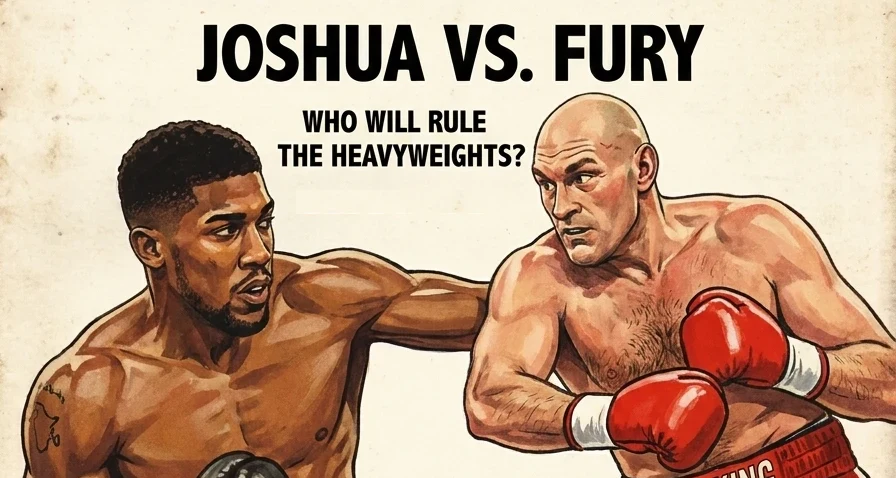
Fury beats Joshua by making the fight long and heavy: feints and a jab that keep Joshua from setting his feet, then leaning his weight on him in the clinch so every round costs Joshua energy. Joshua beats Fury by being first — winning the opening four rounds behind a double jab to the body and the straight right hand he throws better than anyone Fury has faced, before Fury's rhythm settles. Fury (36-2-1, 25 KOs) is 206cm with a 216cm reach and has never been stopped as a professional; Joshua (30-4, 27 KOs) is 198cm with a 208cm reach and has finished 90% of the men he has beaten.
Strip away ten years of noise and Fury vs. Joshua is a simple question: can the better athlete win the fight before the better boxer takes it over? Everything below is an attempt to answer it with what both men have actually shown, not what they have said.
The frame
Fury stands 206cm with a 216cm reach. Joshua is 198cm with 208cm. Fury is 36-2-1 with 25 knockouts; Joshua 30-4 with 27. Those numbers describe the shape of the fight: Fury has the longer levers, Joshua the heavier finish. Fury has never been stopped as a professional. Joshua has, twice.
How Fury wins
Feints before punches. Fury's best nights — Klitschko in 2015, the second Wilder fight in 2020 — were won before the punches landed. Against Klitschko he feinted, shifted stance and took a unanimous decision off a champion who had not lost in eleven years. Against Joshua the feints serve one purpose: to stop Joshua setting his feet. Joshua's right hand is a planted punch. Take the plant away and you take the punch.
● The fight week, in your inbox
Results, the fights that matter next, and the science behind them.
The jab from both sides. Fury switches stance mid-exchange. His southpaw jab has a habit of landing on orthodox fighters who have spent twelve weeks preparing for the orthodox one.
Make him carry you. In the second Wilder fight, Fury walked forward behind the jab and leaned his full weight on Wilder in every clinch; Wilder was gone in seven. Joshua is stronger than Wilder in the clinch, but he is also heavier-muscled, and muscle is expensive to carry into the second half of a fight. If the clinches are long, rounds eight to twelve belong to Fury.
How Joshua wins
Be first. Joshua's two decision losses to Usyk were fights where he waited to see what came back. Waiting against Fury is worse: Fury gets more comfortable with every round he isn't made to answer a question. Joshua's case is built on rounds one to four.
Go downstairs. A double jab to the body brings a tall man's hands down and shortens the distance without walking into the jab. Few people have made Fury pay to the body; Joshua has the power to make it a real tax.
The right hand over the jab. Fury's jab can come lazily, low, from the waist. Joshua's straight right — thrown over the top of it — is the best punch in the fight. Joshua has finished 90% of the men he has beaten; he does not need many clean looks.
The pattern in Joshua's losses
Ruiz in 2019 and Dubois in 2024 both hurt Joshua and then pressed him while he was hurt. Usyk, twice, made him hesitate. Fury is not a Ruiz-style swarmer — he is far more likely to make Joshua hesitate than to rush him. That matters: Joshua's nightmare is the second pattern, not the first. He answered it once already this year, getting up from two first-round knockdowns against Kristian Prenga in July to win in the second, which says his composure under fire is better than it was in 2019.
The swing factor
Ben Davison, Fury's former trainer, is in Joshua's camp for this one. We break down what that knowledge is worth — and where it has an expiry date.
Joshua has to win the fight before it becomes the fight Fury wants. Fury has to survive long enough for it to become one.
The rest of the series: five men who fought both, the ten years it took to make this fight, and what every knockdown tells us.
FAQ
Who has the physical advantage in Fury vs. Joshua?+
Fury: 206cm with a 216cm reach against Joshua's 198cm and 208cm, per their Wikipedia profiles. Joshua has the higher knockout rate — 27 KOs in 30 wins against Fury's 25 in 36.
Has Tyson Fury ever been stopped?+
No. Fury's two losses were both decisions to Oleksandr Usyk in 2024 — a split decision in May and a unanimous decision in December. He has been knocked down several times, including by Deontay Wilder and Francis Ngannou, and got up every time.
How has Anthony Joshua lost?+
Twice by stoppage — to Andy Ruiz Jr. in 2019 (TKO7) and Daniel Dubois in 2024 (KO5) — and twice on points to Oleksandr Usyk, in 2021 and 2022.
Related fighters
BoxingFinesse · Partner
The Vault: rare, by invitation.
Rare and vintage fight pieces, private auctions, limited drops and collections made with pro fighters. The key is free — members see everything first.
- Rare pieces
- Auctions
- Drops & merch
- Fighter collabs
- Tickets & events
- Tools & programs
800+ in the Finesse Club · 500+ vintage magazines