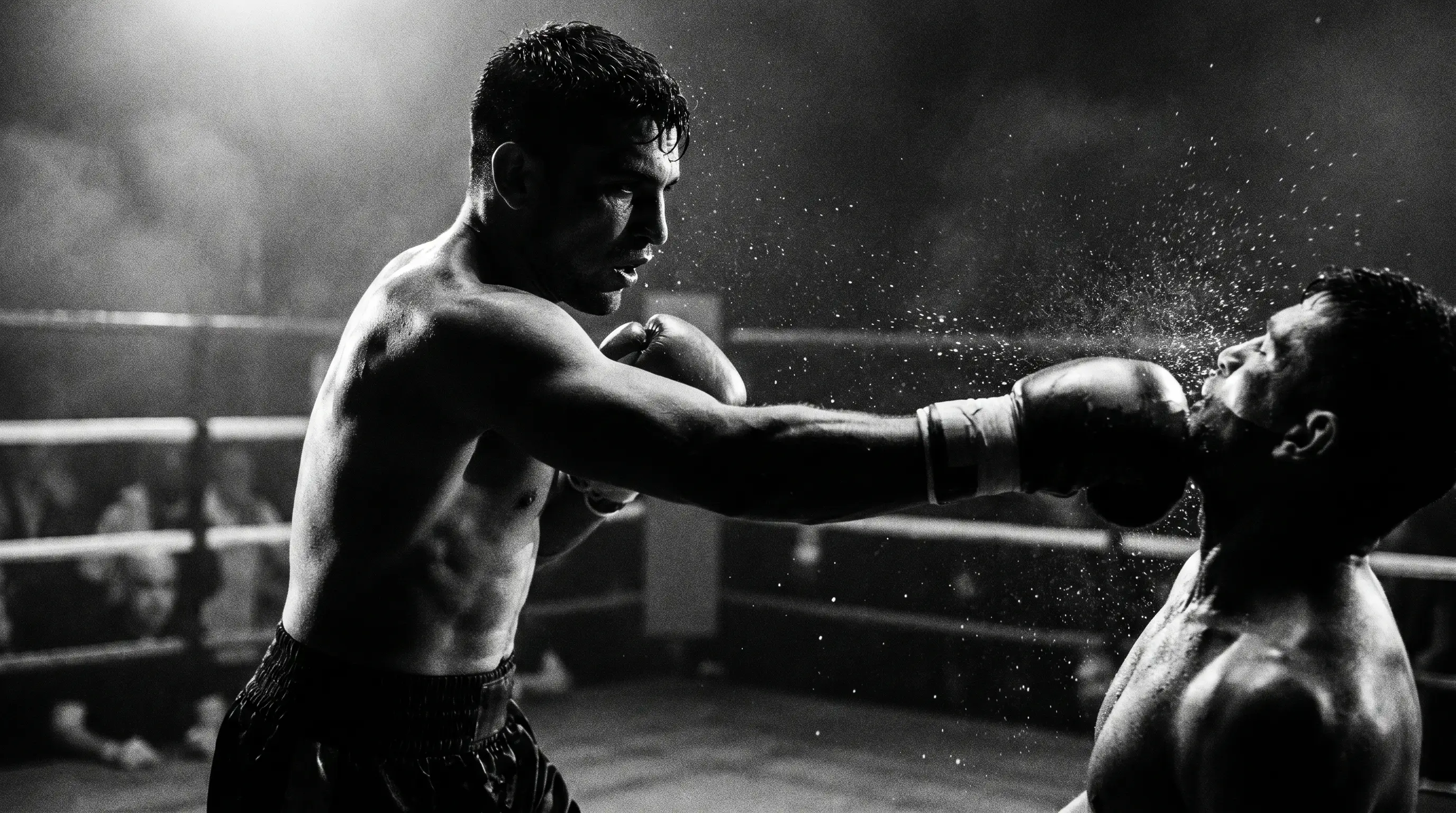
Neck Training for Fighters: The Most Neglected Muscle in Boxing
A stronger neck may help your head accelerate less when punches land. The honest evidence, the safe exercises, and the 10-minute weekly routine old-school gyms never skipped.
The BOXING OS Desk · Jul 17, 2026 · 5 MIN READ

- ✓The mechanism of a knockout is head acceleration — a stronger neck may reduce it. May, not will.
- ✓The honest label: evidence is supportive, not a guarantee. Train the neck AND your defense.
- ✓Start with isometrics: palm against head, resist in four directions, 3×10 seconds each.
- ✓Progress to light, slow, high-rep curls and extensions — never heavy, never to failure.
- ✓Ten minutes twice a week is enough. Old-school gyms did it religiously for a reason.
Fighters train the neck because a stronger neck can reduce how violently the head accelerates when a punch lands — head acceleration, not the punch itself, is a key mechanism in knockouts and concussions. The evidence is suggestive rather than bulletproof: stronger necks are associated with lower head acceleration in impact studies, but no training guarantees protection. The safe protocol: twice a week, 10 minutes — isometric holds in four directions (press your palm against your head, resist, 3×10 seconds each direction), then light dumbbell neck curls and extensions lying on a bench, high reps, slow tempo. Skip bridging until you're experienced; never train the neck to failure.
Walk into a hundred-year-old boxing gym and you'll find a neck harness hanging somewhere near the ring. The old-timers didn't have biomechanics papers. They had pattern recognition.
The honest mechanism Knockouts and concussions aren't caused by the fist — they're caused by what the fist does to the head: sudden acceleration, especially rotational. The brain lags the skull, and the whiplash is the damage. A stronger neck stiffens the head-torso link, and impact research associates stronger necks with lower head acceleration. That's the case for training it — stated honestly: supportive evidence, not a force field. Nothing replaces defense. Nothing replaces understanding what concussions actually are.
The 10-minute protocol (2× per week) - Isometrics, 4 directions. Palm against forehead, push head into palm without moving — 10 seconds. Then back of head, then each side. 3 rounds. - Lying neck curls. On a bench face-up, head off the edge, small plate or no weight on the forehead, chin to chest. 2×15, slow. - Lying extensions. Face-down version of the same. 2×15, slow. - Rule: never to failure, never jerky, never heavy. The neck forgives nothing.
What to skip Wrestler's bridges — until you've earned them under a coach. Loaded cervical spines and ego lifting don't mix.
The neck is the one muscle where the goal isn't performance. It's insurance.
Slot it after training with the Boxing Vault — it takes less time than your cooldown.
FAQ
Does neck training prevent knockouts?+
No training prevents knockouts. Studies associate stronger necks with lower head acceleration on impact, which is the mechanism behind knockouts and concussions — so it likely helps. But defense, chin-tucking and not getting hit clean remain the real protection.
Are neck bridges safe?+
Wrestler's bridges load the cervical spine heavily and have real injury risk when done wrong or too early. Isometrics and lying dumbbell work deliver most of the benefit with a fraction of the risk. Leave bridges to experienced athletes with coaching.
How often should fighters train their neck?+
Two short sessions a week — around 10 minutes each — is the standard that keeps showing up in fight gyms. The neck responds to consistency, not heroic single sessions.
Make it personal to your fight.
Run the free Fighter Check — get your archetype, your Performance System Map and a plan built on what you just read.
Get my System Map →