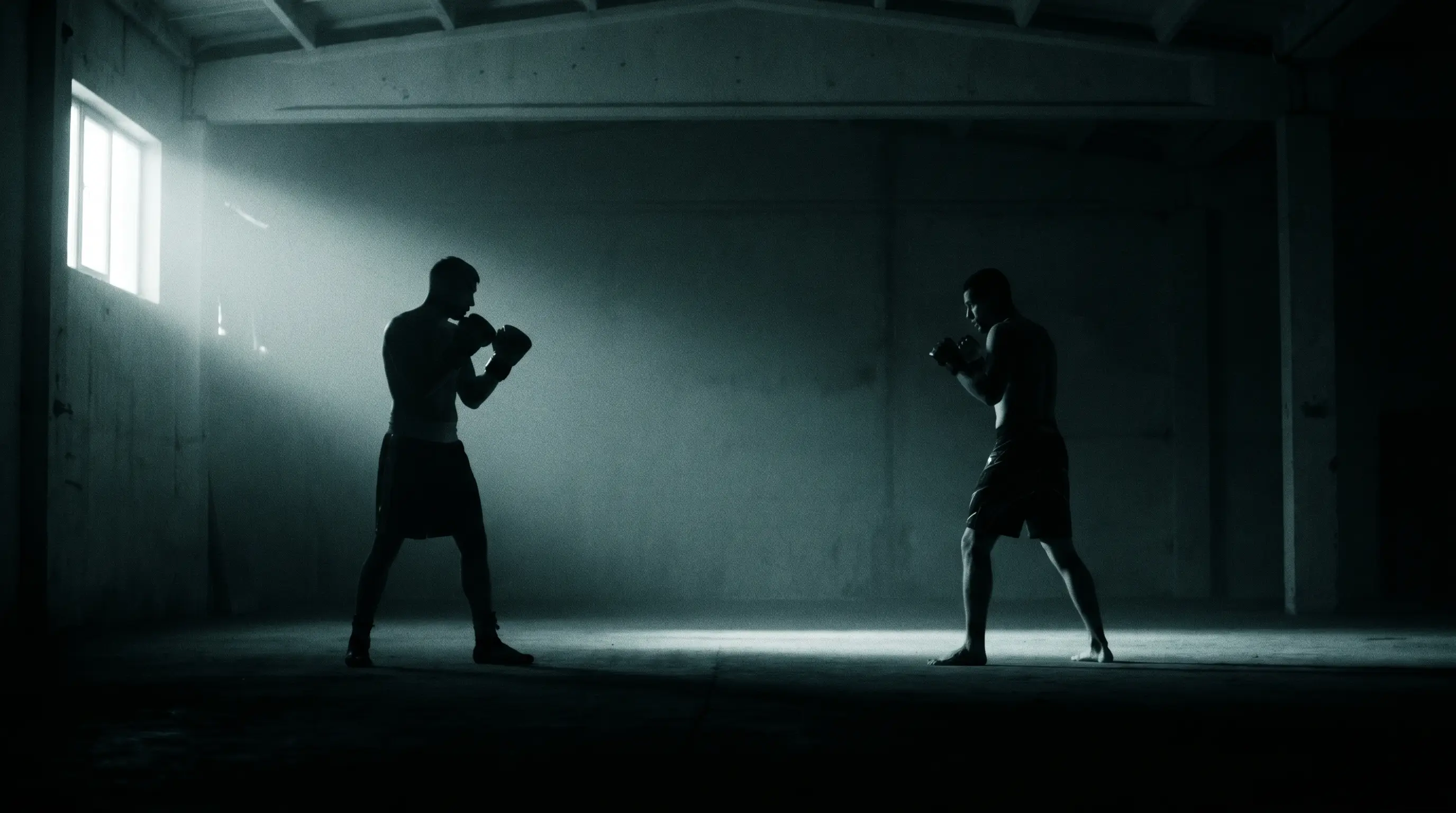
How to Train for Wrestball: The Wrestling Base, the Engine and the Skills the Rules Actually Demand
Training breakdown — what the rulebook demands of an athlete
Wrestball's rules tell you exactly what to train: takedowns for every possession, a suplex worth points, passing without dribbling, and a 20-second clock over three periods plus overtime. A training breakdown built from the rulebook, not the hype.
The BOXING OS Desk · Sep 2, 2026 · 6 MIN READ

- ✓The rulebook is the training plan: contested possessions = wrestling; no dribbling = passing and movement; suplex points = hip power; the clock = conditioning.
- ✓Base skill: takedowns and takedown defense — the athlete who controls position controls the ball.
- ✓Power skill: the amplitude throw is a lift-and-arc; train hip extension, posterior chain and safe throwing mechanics.
- ✓Ball skill: catch, pass and finish under fatigue and contact — a 20-second clock leaves no time to reset.
- ✓Engine: repeated all-out efforts across periods plus possible overtime — interval conditioning, not steady cardio.
Training for Wrestball follows directly from its rules. Because every possession is contested with legal wrestling and there is no dribbling, the foundation is a wrestling base: takedowns, takedown defense and positional control. Because a designated wrestler can score with an amplitude throw — a suplex — hip power and lifting strength matter. Because the ball moves only by passing and movement under a 20-second attack clock, athletes need basketball fundamentals: catching, passing and finishing at the hoop while fatigued. And because games run in periods with a 5-minute extra period and a golden period possible, the engine is repeated high-intensity efforts, not a single sprint. Grapplers with ball skills — or ballers who learn to wrestle — fit best.
We don't need to speculate about how Wrestball athletes should train, because the sport's rules describe the demands precisely. Read them as a coach and a program falls out. This is that program — built from the rulebook, grounded in what fighters already know about wrestling and engines.
1. The wrestling base — because possession is a fight The defining rule: wrestling moves are legal when battling for the ball, and there is no dribbling to protect it. That makes the possession battle a takedown contest, which makes wrestling the base skill of the entire sport.
Train it the way the best grappling systems do: takedowns in the open, takedown defense (sprawls, hand-fighting, hip position), and positional control — the ability to hold ground once you've won it. The Dagestan pressure system is the clearest model: relentless positional dominance that decides where the action happens. In Wrestball, "where the action happens" is who has the ball.
2. Power — because the suplex scores Once per period the designated wrestler can attempt an amplitude throw — lifting the opponent completely off the ground, above the waist, and arcing them onto the mat — for 2 points, and the opponent can counter. That's a specific physical demand: hip extension, posterior-chain strength, grip, and the technique to lift a resisting body safely. Build it with a wrestling coach, technique before load, and the kind of power development that transfers to a lift-and-arc rather than a punch. Note the counterattack rule: throwing badly hands the opponent an opening, so the mechanics matter as much as the strength.
3. Ball skills — the subset that matters No dribbling means most of basketball's ball-handling is irrelevant. What remains is unforgiving: catching under contact, passing accurately while being wrestled, and finishing at the hoop — including the 2-point dunk — with the lungs already burning. Drill catch-pass-finish sequences at the end of grappling rounds, not fresh, because that's when the game asks for them. Shooting from the four scoring zones (1 to 3 points) rewards range, so it's a skill worth owning too.
4. The engine — because the clock never lets you rest A 20-second attack limit means possessions are short and violent. Periods each open with a wrestling battle. A tie adds a 5-minute extra period, then a golden period. The athlete this rewards is the one who can go all-out, recover for seconds, and go again — the grind engine fighters build with interval and grappling conditioning, not the steady-state cardio of distance running.
5. Movement — because you can't dribble your way out With the ball moving only by passing and bodies, spacing and footwork replace dribbling as the offense's structure. Footwork here means creating passing lanes while an opponent is trying to take you down — a blend of a wrestler's stance and a guard's cuts.
Who fits Wrestlers who learn to catch and finish, and physical basketball players who learn to sprawl. The transferable truth we keep seeing across combat sports — that wrestling skill travels anywhere — is the whole thesis of this one. And if you want to find out which of these demands your own body is built for, the Fighter Check maps exactly that.
Read the rules like a coach and the training plan writes itself: wrestle for the ball, throw for points, pass without dribbling, and never be the one who's tired.
Context: the USA Wrestball Cup 2026 and Wrestball's USA expansion.
FAQ
What is the most important skill for Wrestball?+
Wrestling for position. Every possession is contested with legal wrestling moves and there's no dribbling, so the athlete who can take an opponent down — or stop being taken down — controls the ball before any shot happens.
Do you need basketball skills to play Wrestball?+
Yes, but a specific subset: catching, passing and finishing at the hoop under contact and fatigue, and shooting from the four scoring zones. Dribbling isn't part of the sport, so ball-handling matters far less than passing and finishing.
How do you train for the amplitude throw?+
It's a suplex — lifting an opponent completely off the ground and arcing them onto the mat. That's hip extension, posterior-chain strength and lifting mechanics, drilled with a wrestling coach and a partner, with technique and safety before load.
What kind of conditioning does Wrestball need?+
Repeated high-intensity efforts. A 20-second attack clock, periods that each open with a possession battle, and a possible 5-minute extra period plus golden period reward the athlete who can go all-out, recover briefly, and go again — interval and grappling-style conditioning rather than long steady cardio.
Which athletes transition best to Wrestball?+
Wrestlers and grapplers who add ball skills — the possession battle is their home — and physical basketball players who learn takedown defense. Both need the same engine.
Related fighters
Make it personal to your fight.
Run the free Fighter Check — get your archetype, your Performance System Map and a plan built on what you just read.
Get my System Map →