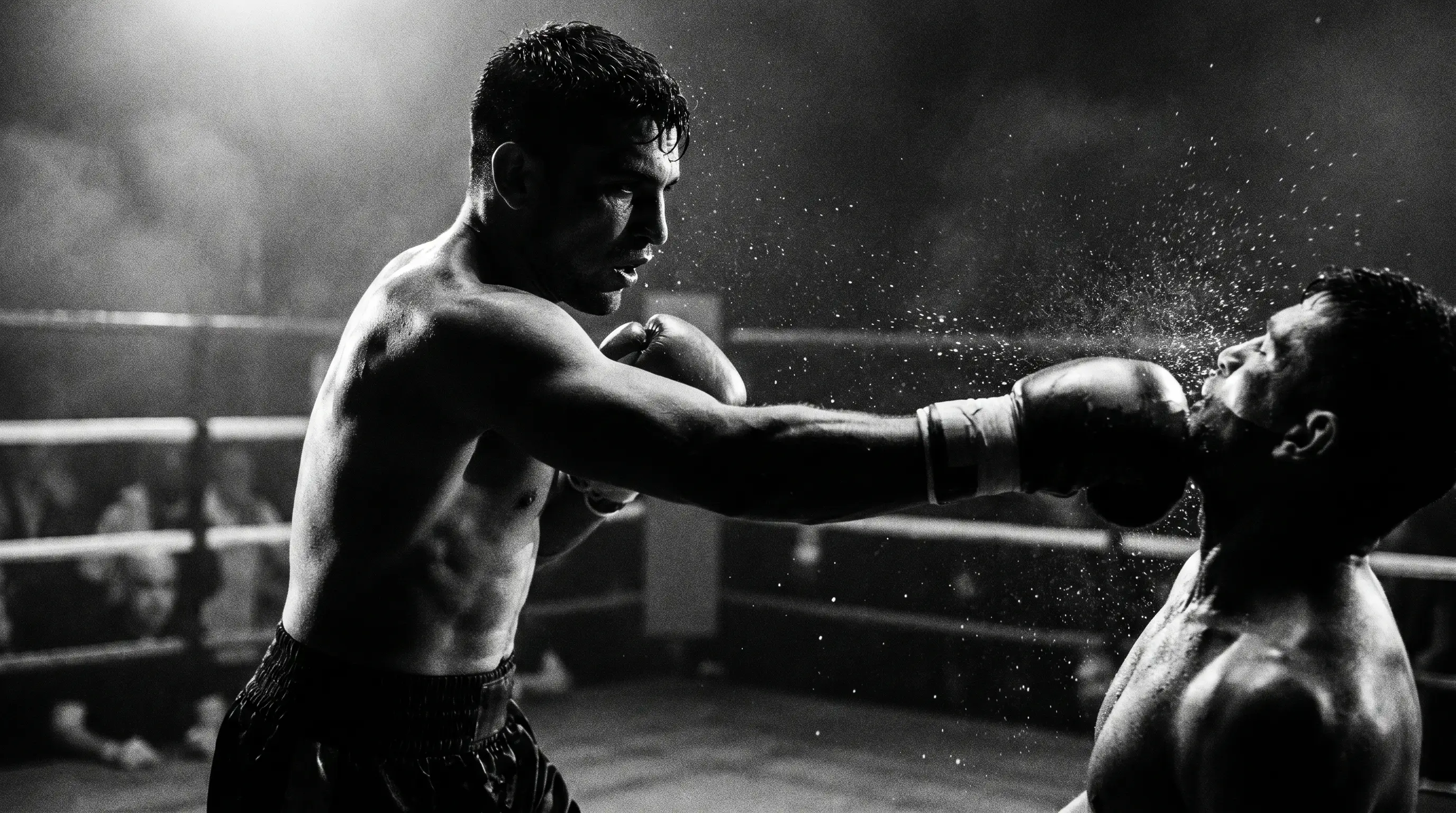
Distance Management: The Invisible Skill That Decides Every Fight
Before any punch matters, someone decided the range it was thrown at. The four distances of boxing, and how the fighter who manages them wins fights on cruise control.
The BOXING OS Desk · Jul 17, 2026 · 5 MIN READ

- ✓Four distances: out of range, long, mid, inside — each with its own legal weapons.
- ✓The fight happens at whoever's preferred range wins the negotiation — that's the real contest.
- ✓The half-step-out position: close enough to threaten, far enough that everything falls short.
- ✓The jab is the fence: it doesn't just score, it enforces the property line.
- ✓Constant small adjustments beat big reactions — range is maintained, not rescued.
Boxing has four functional distances — out of range (safe, where reading happens), long range (jab and cross territory), mid range (hooks and uppercuts join), and inside (short rotational punches and hand-fighting) — and distance management means dictating which one the fight occupies and when. The tools: the jab as a rangefinder and fence, footwork that maintains your gap by constant small adjustments (not reactions), and understanding that your ideal range is wherever your best weapons work and theirs don't. The masters spend most of each round a half-step outside the opponent's reach — close enough to threaten, far enough that everything incoming falls short.
Two fighters of equal skill meet. One decides where the fight happens; the other decides nothing. The scorecards will read like a mismatch — and the invisible skill responsible almost never gets named on commentary.
The four distances - Out of range — nobody lands anything. The observation deck: reading, resting, resetting. - Long range — jab and cross country. The tall and rangy live here. - Mid range — hooks and uppercuts join the conversation. Most exchanges, most damage. - Inside — the phone booth: short rotation, hand-fighting, head position.
Every fighter is dangerous at some distances and merely present at others. The real contest is which range the fight occupies — the punches are just how the winner of that contest collects.
The half-step-out throne The masters' preferred residence: a half-step beyond the opponent's reach. From there, your committed step lands you in range to strike — but everything they throw without a full telegraphed entry falls short. It looks passive on television; it's the most aggressive real estate in the ring, because you own both the threat and the veto.
The jab as property line The jab's deepest job isn't scoring — it's enforcement. A constantly threatening jab makes every entry expensive; opponents stop strolling into their range and start paying admission. No fence, no boundary; no boundary, no management.
Maintenance, not rescue Watch elite feet: never still, always making centimeter adjustments before the range breaks. Amateur distance-keeping is a panic response after the gap collapses; professional distance-keeping means the gap never collapses unwatched. It's the difference between steering and crashing politely.
The fight is a negotiation about where the fight happens. Bring your feet to the table.
Build the engine underneath it: the footwork guide and ali-style movement.
FAQ
What are the ranges in boxing?+
Four: out of range (nobody can land — the reading distance), long range (jabs and crosses), mid range (adds hooks and uppercuts), and inside (short punches, hand-fighting). Every fighter has ranges where they're dangerous and ranges where they're ordinary — managing which one the fight lives in is the meta-game.
How do I control distance in a fight?+
Three tools: a constant jab that enforces your boundary (the fence), continuous small foot adjustments that maintain the gap before it breaks (management, not rescue), and positioning a half-step outside their reach — where you can step in to strike but their attacks fall short without a full committed entry they must telegraph.
Why do I always end up fighting at the wrong range?+
Because the opponent is managing distance and you're only reacting to it. The fix is deciding before each round where you want the fight (where do your best weapons beat theirs?) and spending your feet on maintaining that — treating every unwanted range change as a problem to fix immediately, not once cornered.
Make it personal to your fight.
Run the free Fighter Check — get your archetype, your Performance System Map and a plan built on what you just read.
Get my System Map →