Boxing at Home With Zero Equipment: The Complete System
No bag, no gloves, no excuses — the shadowboxing-centered program that builds real skill in a living room.
The BOXING OS Desk · Jun 27, 2026 · 5 MIN READ
- ✓Shadowboxing is the core, not the fallback — champions never stop doing it.
- ✓Round format is the secret: 3 on, 1 off turns a living room into fight conditioning.
- ✓Two square meters trains footwork completely: box patterns, pivots, in-and-outs.
- ✓What home can't give: impact feedback and live opponents — park them, don't fake them.
- ✓Film one round per week; the camera is the free coach everyone owns.
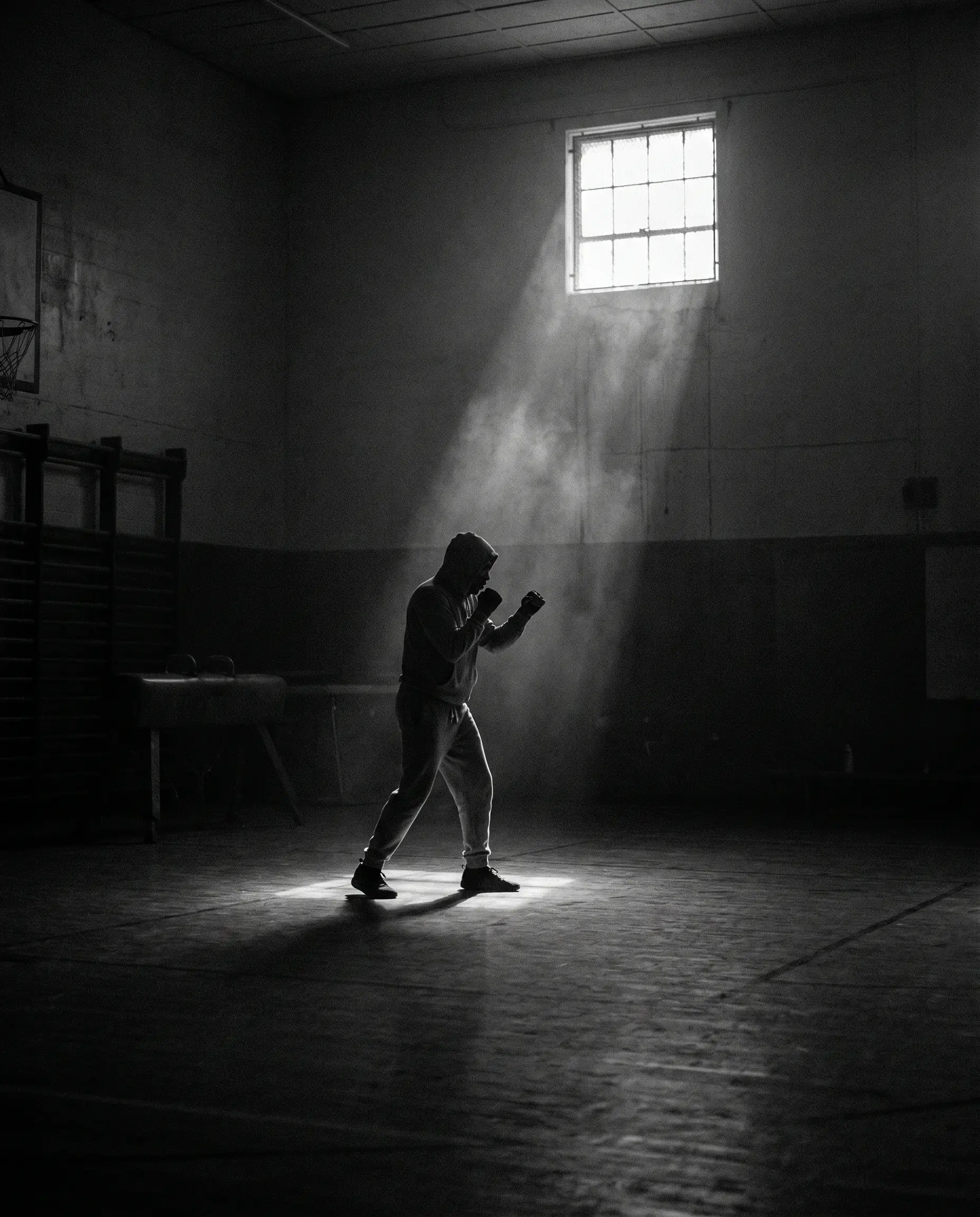
Real boxing skill is trainable at home with nothing: shadowboxing carries technique (stance, punches, combinations, defense), footwork drills need two square meters, and fight conditioning comes from bodyweight circuits in round format (3 minutes on, 1 off). A complete session: 3 rounds themed shadowboxing, 2 rounds footwork patterns, 3 rounds bodyweight circuit (burpees, squats, push-ups, core), 1 round defense-only. The honest gaps of home training — impact feedback and live timing — wait for a gym, but everything they'll sit on top of builds at home.
The excuse economy around boxing is robust: no gym nearby, no gear yet, no time this month. Meanwhile the most portable serious sport on earth requires, at entry level, a body and two square meters of floor.
The core truth Shadowboxing isn't the poor cousin of real training — it's where technique actually gets built, at every level of the sport. Bags and pads calibrate what shadowboxing constructs. Which means the couch-distance version of boxing is not a compromise program; it's the first program, done where you live.
The 9-round home session On a timer — three minutes on, one off (the built-in round timer runs it from your pocket):
Rounds 1–3, shadowboxing with themes. One: fundamentals — stance, jab, movement. Two: combinations, each ending with a defensive move. Three: an imagined opponent with a style, being solved.
Rounds 4–5, feet only. Box patterns around a floor tile, pivots at each corner, in-and-out darts. Ugly is normal; week three is smoother.
Rounds 6–8, the engine. Bodyweight circuit at fight rhythm: burpees, jump squats, push-ups, plank punches — work the full three minutes, rest the one.
Round 9, defense. Slips, rolls, pulls against imagined punches. Hands home the whole round.
The two honest gaps Impact feedback and live timing can't happen in a living room. Fine — park them. They're waiting at any gym, and they'll land on a foundation instead of on nothing.
The gym builds fighters. The living room decides who shows up already dangerous.
The no-equipment sessions script every round of this — timer, themes and all.
FAQ
Can you actually learn boxing at home?+
The foundation, genuinely: stance, punches, footwork, combinations and defensive movement all build through structured shadowboxing. What home can't provide is impact calibration (bags/pads) and live timing (sparring) — so home-built skill needs a gym eventually, but arrives there far ahead.
What's a good home boxing workout without equipment?+
Nine rounds of 3 minutes with 1-minute rests: 3 themed shadowboxing rounds (fundamentals, combinations, imagined opponent), 2 footwork-only rounds, 3 bodyweight-circuit rounds (burpees, squats, push-ups, core), 1 defense-only round. Thirty-five minutes, complete session.
How do I know my punches are correct without a coach?+
Film yourself — a phone at chest height is a merciless, patient coach. Check one variable per week (guard return, hip rotation, balance after combinations) against reference footage. One corrected error a week compounds fast.
Make it personal to your fight.
Run the free Fighter Check — get your archetype, your Performance System Map and a plan built on what you just read.
Get my System Map →