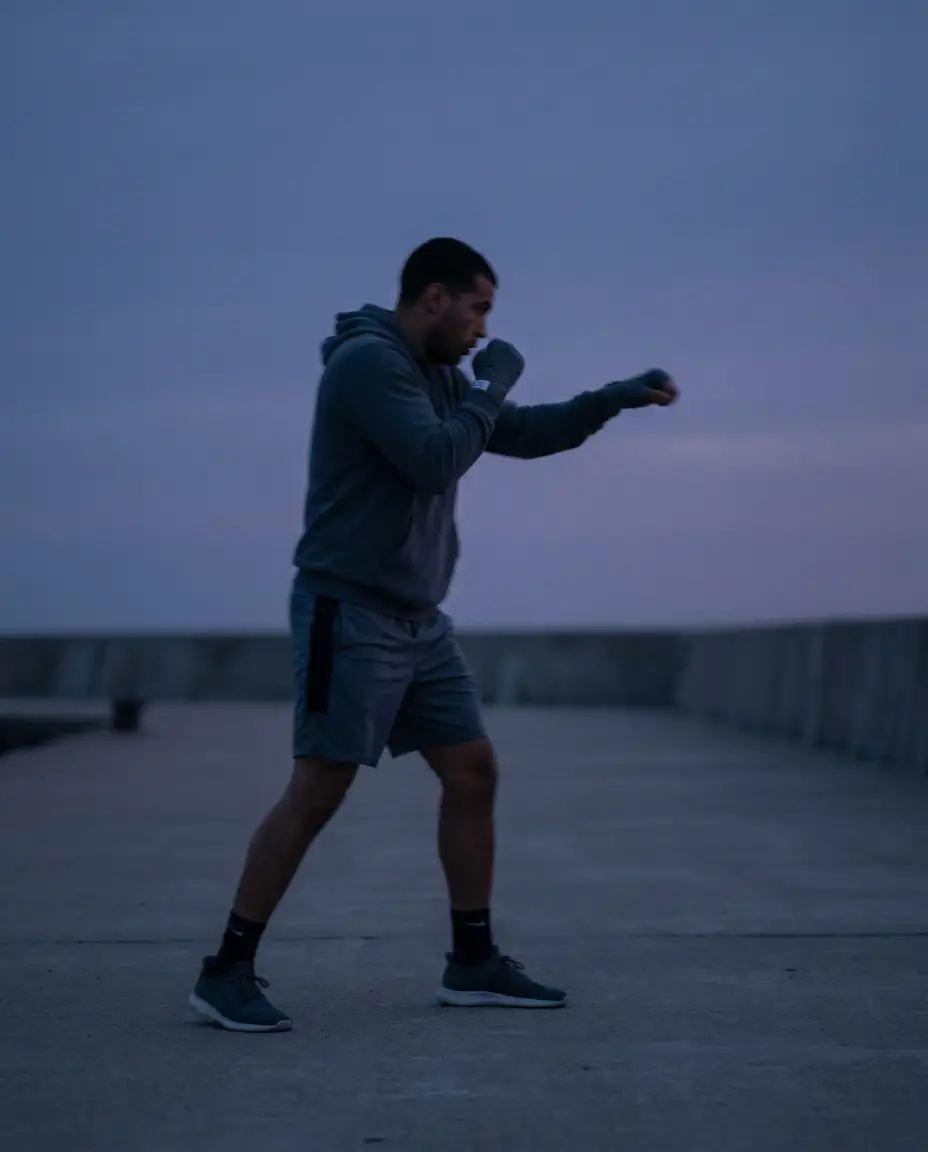
Boxing for Anxiety: Why the Nervous People Stay the Longest
The counterintuitive truth coaches see constantly: the anxious, the shy and the overthinking often become the gym's most devoted members. The honest why.
The BOXING OS Desk · Jul 17, 2026 · 5 MIN READ

- ✓The focus demand is the mechanism: you cannot ruminate and box at the same time.
- ✓Hard exercise discharges the stress physiology that anxiety keeps topped up.
- ✓Skill progression rebuilds self-trust in small, honest, measurable steps.
- ✓Controlled manageable stress teaches the nervous system that arousal is survivable — at your pace, contact never required.
- ✓It's a powerful complement to professional support, not a substitute for it.
Boxing helps anxious people through mechanisms that are boringly practical rather than mystical: intense exercise reliably discharges stress physiology; the sport's total demand for present-moment focus interrupts rumination better than most meditation because you can't think about Monday while slipping a jab; measurable skill progression rebuilds self-trust in small honest increments; and controlled exposure to manageable stress (bagwork, drills, eventually light contact if chosen) trains the nervous system that arousal can be survived and used. It complements — never replaces — professional help where that's needed, and no gym should push contact on anyone as therapy.
Ask veteran coaches who stays longest and a surprising answer recurs: not the athletes, not the tough kids — the nervous ones who almost didn't walk in. There are real reasons.
You can't ruminate and slip a jab Anxiety lives in loops — replayed conversations, rehearsed catastrophes. Boxing's demand for total present-moment attention breaks the loop mechanically: the bag, the combination, the timer occupy the exact cognitive machinery rumination needs. People who fail at sitting meditation routinely find moving meditation here, three minutes at a time.
The chemistry does its part Anxiety keeps stress physiology topped up with nowhere to go. Hard rounds give it somewhere to go. The post-training calm that fighters describe isn't mystique — it's discharge, and it's reliably repeatable.
Confidence, in honest increments Anxiety erodes self-trust. Skill progression rebuilds it in a currency that can't be faked: four weeks ago the rope defeated you, today it doesn't. The double-end bag humiliated you in March; by May it can't. These are small, objectively real victories, and they compound into a different self-story.
Stress inoculation — at your pace Training is controlled exposure to manageable stress, and the nervous system learns from it: elevated heart rate, adrenaline, pressure — survivable, even usable. That lesson generalizes to job interviews and hard conversations. And it requires exactly as much contact as you choose, including none.
The honest boundary: boxing complements professional help; it doesn't replace it where it's needed. Both, together, is a strong corner.
The gym doesn't cure anxiety. It gives it somewhere useful to live.
Start smaller than the gym if you need: the breathwork pacer is free, and the plan meets you where you are.
FAQ
Can boxing help with anxiety?+
Many people report meaningful help, through practical mechanisms: intense exercise discharges stress chemistry, the total focus requirement interrupts rumination, and steady skill progress rebuilds confidence. It works best as a complement to, not a replacement for, professional support where that's needed.
I'm too anxious to walk into a boxing gym — what helps?+
Three door-lowering moves: email ahead and say you're a nervous beginner (coaches respond well to honesty and will tell you exactly what to expect), attend a beginner-specific class where everyone is equally new, or build two weeks of shadowboxing basics at home first so the vocabulary isn't foreign. The door is the hardest rep.
Do I have to spar or get hit for the benefits?+
No. The focus, fitness, discharge and confidence mechanisms all operate fully in non-contact training — bags, pads, drills. Contact is a separate, always-optional choice, and any gym pushing it as mandatory therapy has failed the culture test.
Make it personal to your fight.
Run the free Fighter Check — get your archetype, your Performance System Map and a plan built on what you just read.
Get my System Map →