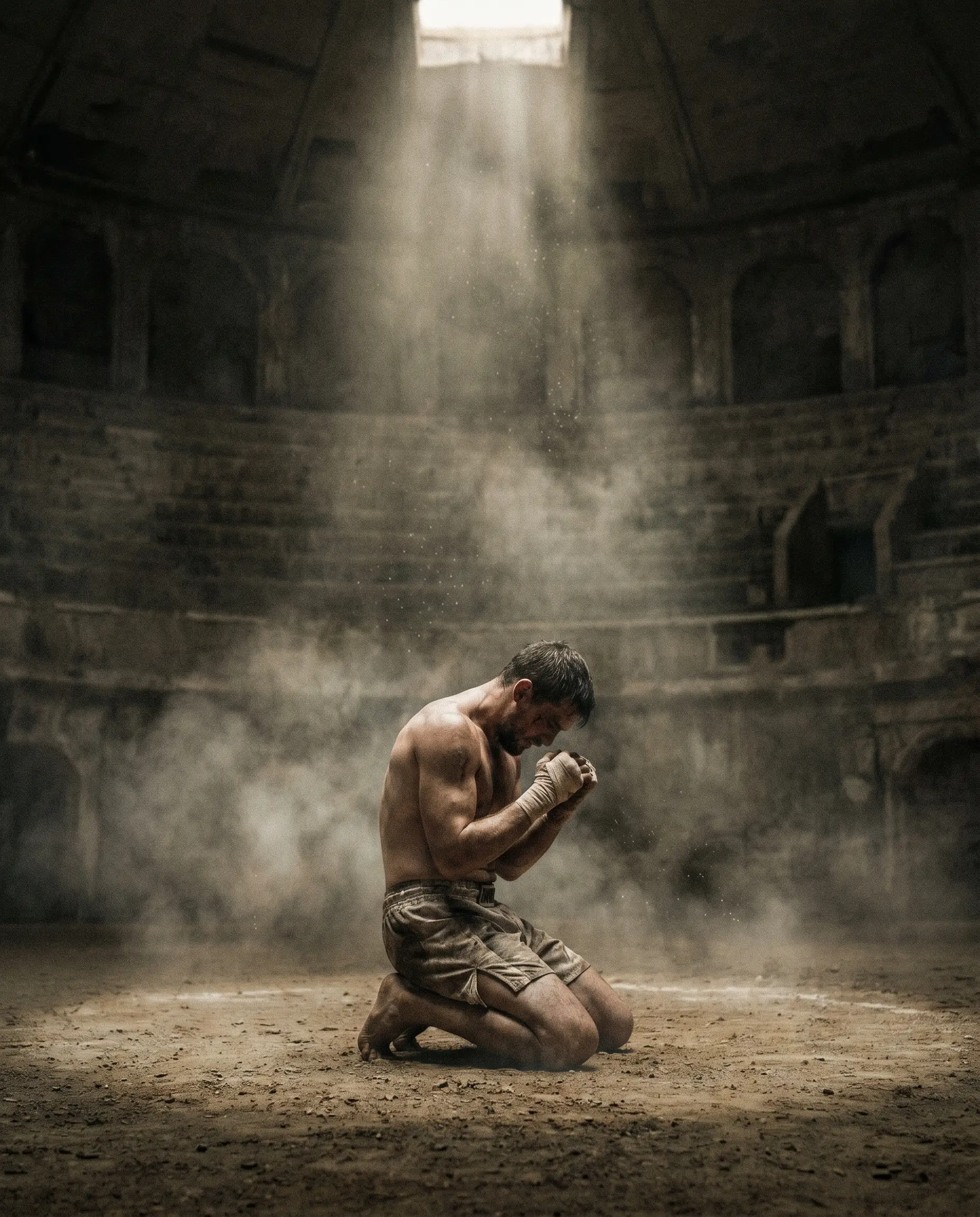
The arena is loud, but inside the tunnel it is so quiet you can hear your own heart auditioning for the role of coward.
People ask me about the punches. The knockouts. They never ask about the walk. Forty steps from the dressing room to the ropes, and those forty steps are the realest part of the whole night.
I have thrown up before the walk. I have cried before the walk. Once, in an amateur show in a leisure centre that smelled of chlorine and fried onions, I prayed to a God I wasn't sure I believed in to please, please let me faint so I wouldn't have to go out there.
He didn't. I went out there.
Courage isn't the absence of fear. It's deciding the fear doesn't get to drive.
Here is what nobody tells you: the fear never leaves. Twenty fights in, it still meets me in that tunnel, same as the first night. The difference now is that I know its face. We've met. I let it walk beside me instead of in front of me.
My coach used to say *the fight is won in the boring weeks.* The 5am roads nobody filmed. The rounds when my arms were lead and I threw them anyway. By the time I make the walk, the fight is already mostly decided — by a thousand small choices made by a version of me who was tired and chose to be excellent regardless.
So the walk isn't where I find courage. It's where I collect it. Every honest session is a deposit, and the tunnel is where I withdraw.
I lost my biggest fight. I want to tell you that so you don't think this is a fairy tale. I made the walk, I gave everything I had built, and the other woman had built more. I sat on the stool after, face swelling, and I was not destroyed. Because the walk had already given me the only thing it can promise: I knew I had not flinched.
They can take the decision. They cannot take the walk.
If you are reading this in a tunnel of your own — a real one, or the kind made of bills, or grief, or the quiet certainty that you are not enough — I need you to know something.
The walk is not the punishment. The walk is the proof. You are the kind of person who goes out there.
Forty steps. Go.
— Amara
Amara Okonkwo · Welterweight · London
Pass the fire on
Take it with you
Every letter here is a lesson wearing a story. This one: everybody sees the fight. nobody sees the forty steps before it — the ones where you meet yourself. Read it twice, then do one small thing about your own version of it — today, not Monday.
Did this land?
Leave a corner note
What did this story touch in you? Someone in the same round needs to read it. Notes are reviewed before they appear.
The quiet corner
These stories exist because most men carry their heaviest rounds alone. Talking is not weakness — it's the same courage as the walk. If this story sits heavy on you, do one thing today: two minutes of breathing, a message to someone you trust, or a professional's ear. That's training too.
The system behind the story
Amara fights as a Maestro — composure as a weapon. See the system she trains.
Train The Maestro →You've made the walk too
Your story belongs here.
No fame required. Tell us a sentence — we'll help you tell the rest.
No fame required. Every fighter has a story worth telling.